

Oct 19
6 MIN READ
Payop introduces a new checkout

Oct 07
6 MIN READ
Top gaming payment methods in 2026

Sep 28
6 MIN READ
Why users abandon mobile payments and how to fix it
Sep 21
6 MIN READ
The EU Instant Payments Regulation explained

Sep 11
6 MIN READ
Gamescom 2026 recap: What matters for online gaming businesses

Sep 04
6 MIN READ
The biggest business trends from Gamescom 2026
← All articles
Fraud trends to watch out for in 2026
In 2026, AI-driven fraud is the biggest threat to online payments. According to recent research, AI is now involved in 42.5% of detected fraud attempts, with around 29% of them being successful. Criminals use this technology to bypass verification systems, automate attacks, and launch complex, large-scale schemes that can cause serious financial and operational losses for businesses.
In this article, we explore the main fraud trends in 2026 and steps you can take to keep your transactions safe.
The most important fraud trends impacting online payments
We all interact with AI almost every day, and let`s be honest, it makes work and everyday-life tasks much easier. The newest generation of AI, known as agentic AI, can perform complex tasks with minimal human oversight, making decisions, setting goals, and learning from mistakes to complete a task.
Unfortunately, new technologies also enable more sophisticated fraud. Criminals can now use Agentic AI to steal data and target thousands of users at once. Attacks adapt to victim responses in real time across multiple channels, including email, phone, text, and social media.
To ensure secure payments, it`s important to understand the threat, so let`s take a closer look at the forms these attacks usually take.
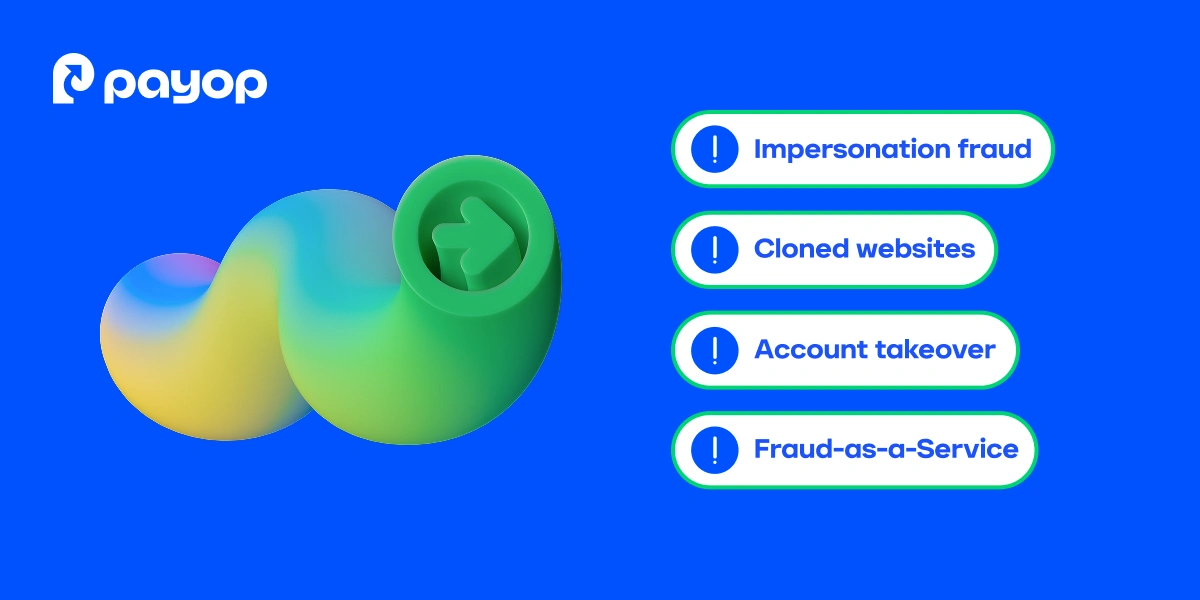
Impersonation fraud
Impersonation fraud is expected to be one of the biggest dangers for merchants in 2026. In simple terms, fraudsters pretend to be someone you trust to trick you into approving payments or sharing sensitive information.
The danger comes from hyper-personalisation. Agentic AI can clone voices, mimic writing styles, generate deepfakes, and reference real projects or personal details to gain trust. It learns from every interaction, analysing what works, adjusting tactics, and making each attempt more convincing than the last.
Examples of impersonation fraud include:
Business Email Compromise (BEC): Criminals pose as colleagues, executives, or suppliers via messages or emails and convince employees to send them money or share sensitive information.
Synthetic identity fraud: Fraudsters create fake customer profiles using a mix of real and fabricated personal data. Such 'customers' can open accounts, make purchases, and pass verification checks. Because the identity appears genuine, merchants may ship goods, provide services, or approve payments they believe are legitimate.
Cloned websites
AI tools can now replicate real websites down to the smallest detail layouts, logos, product pages, even checkout flows. These fake sites can look almost identical to the original, making them hard for customers to spot.
Once users enter their payment details on a cloned site, fraudsters can reuse that data for card fraud, account takeovers, or identity theft. Beyond direct financial losses, these scams damage brand reputation and reduce customer trust. It often leads to lost sales long after the fake site is taken down.
And removing them isn`t simple. By the time one phishing domain is reported and blocked, several copies may already be live.
Account takeover
Account takeover happens when fraudsters gain control of a real customer`s account. AI tools make it much easier. Attackers can scan massive datasets at once and target accounts with weaker protection and stored payment methods. But that`s just the beginning.
AI-bots can now mimic human behaviour, including typing speed and cursor movement, and even fake a unique device fingerprint. Criminals use this technology to trick security systems after hijacking the account. This way, the takeover goes unnoticed until the customer spots an unauthorised transaction and files a dispute. By then, the merchant is left dealing with chargebacks, financial losses, and operational pressure.
Fraud-as-a-Service (FaaS)
Fraud-as-a-Service (FaaS) is another trend for 2026. It`s a service model in which criminals can rent or buy ready-to-use tools to commit fraud, including AI-powered phishing kits and bots that bypass CAPTCHAs. Stolen data can also be purchased or sold via marketplaces.
This 'plug-and-play' model lowers the barrier to entry. As a result, more attackers can launch scams with minimal technical skills, increasing both the volume and the sophistication of fraud attempts. For merchants, that means greater pressure on fraud and risk teams to detect and stop threats faster.
How online businesses can reduce fraud risks
AI helps fraudsters to bypass traditional defences. The solution is to fight fire with fire and use AI-powered fraud protection tools to ensure secure payments. Consider such measures as:
Device intelligence: identifies suspicious devices. If a customer usually logs in from one country, and then a login attempt suddenly comes from a new device in another location, the system flags it as high-risk.
Behavioural biometrics: analyses how a user interacts with the device, including typing speed, swipes, or navigation patterns. Even if credentials are correct, unusual behaviour can mean account takeover.
Anomaly detection: monitors accounts for unusual activity, such as sudden high-value purchases.
Risk-Based Authentication (RBA): protects logins and account access using signals from device intelligence, behavioural biometrics, and anomaly detection. RBA can require extra verification or block the login in real time.
Real-time transaction monitoring: protects online payments using the same signals as RBA. When a transaction looks risky, this system can block it, flag it, or request proof of identity.
Advanced Document Verification (ADV): checks whether the document is real or AI-forged.
For even better security, consider phishing-resistant multi-factor authentication(MFA). Traditional MFA asks you to enter a password and a one-time code sent via SMS or an app. However, even this system has weak points. Fraudsters can send fake emails and create lookalike login pages to trick users into entering both their password and the one-time code.
This is where phishing-resistant MFA comes in. Instead of one-time codes, it uses public-key cryptography. When a user first registers, a unique key pair is created: the private key stays securely on the user`s device, and the public key is stored by the service provider. During login, the real website sends a security challenge. The user`s device signs it with the private key, and the server verifies it using the stored public key.
Because authentication is tied to the specific website, device, and unique challenge, a phishing site cannot copy, reuse, or forward the login attempt.
How a payment service provider reduces fraud risk
Fraud trends are moving fast. With a strong payment service provider, your protection should move faster.
At Payop, we built fraud prevention directly into the payment processing flow. Real-time monitoring, smart risk scoring, device checks, and behavioural analysis work in the background, blocking suspicious activity before it becomes a chargeback.
You also get access to safer payment methods. Solutions like Pay by Bank reduce chargeback exposure by allowing customers to approve payments directly in their banking apps.
Altogether, it means secure payments, fewer disputes and more control over your revenue. Plus, all of this without slowing down your checkout.
More similar blogs
Oct 07
4 MIN READ
Top gaming payment methods in 2026
Sep 28
4 MIN READ