


Oct 07
7 MIN READ





Voice assistants have quietly become part of everyday life. People ask them to play music, set reminders, check the weather, and control smart home devices.
Today, voice technology is growing quickly and also entering the world of online payments. It creates new ways for customers to buy products, sometimes without even touching a screen. This raises an important question: are virtual assistants like Alexa and Siri truly ready to handle digital payments?
Let’s explore how this technology works and what opportunities and challenges it brings for e-commerce.
Voice-activated payments let customers make online transactions by speaking a command. Users simply ask a virtual assistant to make a purchase, send money, or reorder a product. The system then requests confirmation from the customer and handles the rest. Behind the scenes, artificial intelligence, machine learning, and natural language processing allow assistants to understand and respond to voice commands.
These online payments only work on devices with a voice assistant, such as a smartphone, smart speaker, connected car, or smartwatch. But that’s not all. First, the device must support payments via that specific assistant. Second, voice-activated payments must be available in the user’s region. For example, voice shopping with Alexa is only available in countries where Amazon Pay supports such transactions. Similarly, Siri can make digital payments through Apple Pay or third-party apps. But even in regions supporting Apple Pay, the device type and settings determine whether a customer can use voice transactions.
While the exact steps may vary by assistant, the process is usually the same:
1. Setup and account linking
First, the user links their virtual assistant to a payment method. This typically includes a credit or debit card, a bank account, or a digital wallet. Some assistants also support additional options, such as Amazon Pay for Alexa and Venmo and PayPal for Siri.
2. Voice command
The user speaks a command, such as “reorder coffee pods,” “pay my electricity bill,” or “send $20 to Sam.” Alexa and Siri support different requests, so each one must fit the assistant’s capabilities.
3. Authentication
The system verifies the user’s identity to prevent unauthorised transactions. Alexa usually uses voice recognition and an optional 4-digit voice PIN. Siri relies more on device authentication, including Face ID, Touch ID, or a passcode.
4. Transaction processing
Once the user is verified, the digital assistant sends a transaction request to the payment platform, which forwards it to the bank. The bank then authorises the payment and completes the transaction using the linked payment method.
5. Notification
After successful payment processing, the assistant notifies the user via a voice message, an in-app alert, or an email. The notification usually includes key details like the amount paid, the recipient, and the payment method used. This way, the user can quickly check that everything was completed correctly.
Paying online with voice is winning over more and more users, and here’s why:
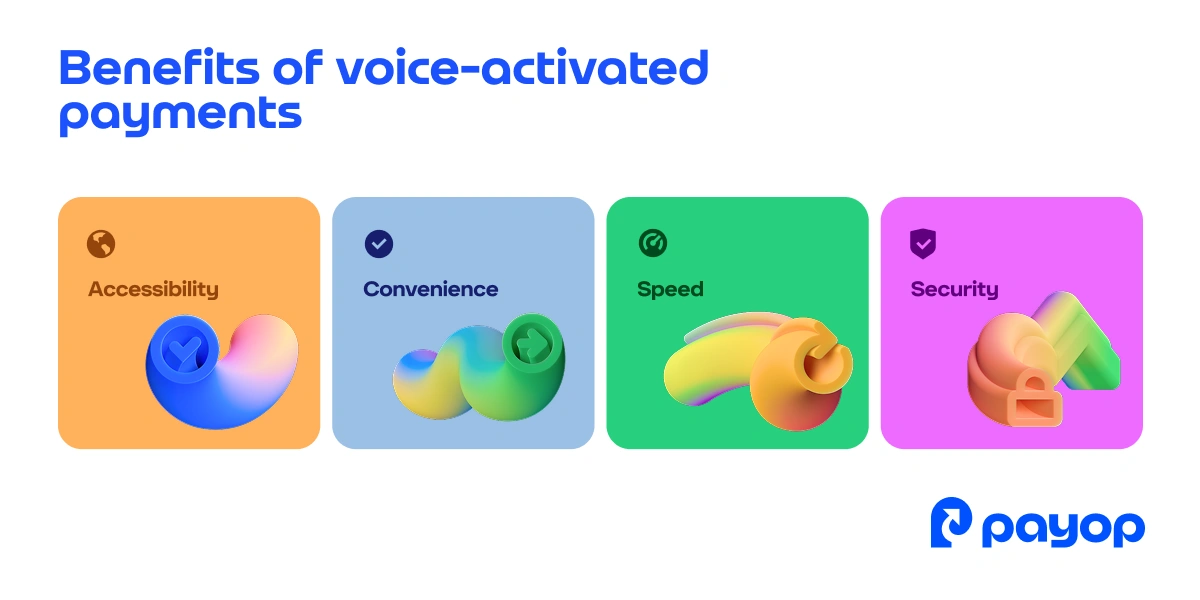
Voice-activated payments make online shopping more accessible for everyone, especially people who might struggle with traditional screens or buttons.
As long as the user’s region doesn’t require extra steps for voice checkout, repeated orders via Alexa can be totally hands-free. Just imagine: while a customer is cooking or exercising, a simple command like “Alexa, reorder dog food” initiates the transaction. The entire process is almost invisible to payers, and customer satisfaction is higher.
Another great benefit of voice payments is speed. Instead of typing card details or navigating through multiple screens, customers just speak a command. With a one-time setup, online transactions happen much faster than manual entry, making the payment experience smooth and almost effortless. Perfect for busy payers who don’t want to lose time filling out checkout forms.
Voice-activated transactions are secure because they rely on biometrics to recognise a user’s unique voice patterns, which makes impersonation very difficult. On top of that, most systems add extra authentication layers, like PIN codes, Face ID, or Touch ID for stronger protection.
Despite their advantages, voice-activated payments remain an evolving technology with its challenges.
Let’s take a closer look at them.
One of the main obstacles to the broader adoption of voice transactions is a lack of trust in the key component: voice assistants. Some users worry that their private conversations could be recorded and stored.
In reality, Siri and Alexa don’t allow that kind of privacy violation. They only start listening after hearing their wake word, such as “Alexa” or “Hey Siri.” The commands users give are sent to the company’s servers and may be temporarily stored to improve speech recognition. Users can view and delete these recordings, so nothing is kept permanently without their control.
A better understanding of this technology builds user trust. And as virtual assistants become more common, voice-activated payments will likely become a standard habit, too.
Accuracy is another challenge for this technology. Voice recognition has improved a lot in recent years, but it isn’t perfect yet. Virtual assistants may struggle to understand a command due to background noise, unclear phrasing, or strong accents. Sometimes a misinterpretation can even trigger an unintended action.
This is why additional security measures, such as PIN codes, Face ID, or Touch ID, are so important for virtual assistants. They provide good protection against unintended payments, but misheard commands still happen. Because of this, some customers can hesitate to use digital assistants for shopping. Improving the accuracy and reliability of this technology is key to making voice payments more trusted and popular.
Voice biometrics identify a person based on unique voice characteristics. But if a customer is sick, tired, or using a microphone on another device, they may sound different. In such cases, the system might fail to recognise the authorised user, blocking the payment.
There’s also the risk of false positives when the system mistakenly matches someone else’s voice to the registered user. Modern voice biometric systems minimise this risk, but it can still happen sometimes. Especially on shared devices like household smart speakers, where multiple people interact with the assistant.
Additional authentication layers prove useful here, again. Even if voice recognition fails, security measures help prevent unauthorised payments.
Even though voice assistant technology is evolving rapidly, the number of languages they support is still limited. For instance, Alexa understands over 10 languages, while Siri supports more than 20. That’s already a lot. But assistants mainly cover what are considered “major” languages, excluding millions from using this technology. And even when an assistant supports a language, it doesn’t always enable voice payments. As a result, the actual audience shrinks even more.
Developers still have work to do. The system must become not only more accurate and reliable, but also capable of recognising more languages and regional accents. That way, voice transactions become a convenient reality for everyone.
Voice assistants are playing an increasingly important role in online payments. Today, they can handle simple purchases, repeat orders, and peer-to-peer transfers, making digital transactions faster and hassle-free. While the technology is still evolving, improvements in artificial intelligence and voice recognition are making these systems more reliable.
This is a clear signal for merchants: voice-activated payments may soon reshape online shopping. And in the fast-changing world of e-commerce, staying aware of trends and offering the best customer experience is key to success.