Apr 04
6 MIN READ

Banking apps are becoming a bigger part of online shopping. Today, customers can pay for online purchases directly from their banking accounts, without entering card details.
This is where account-to-account (A2A) payments and Pay by Bank come in. But what exactly do these terms mean? Let's break down the connection between the two and explore the opportunities they offer online businesses.
Account-to-account (A2A) payments transfer money directly from one bank account to another, skipping card networks such as Visa or Mastercard. The same principle applies to traditional bank transfers and direct debits. Modern payment infrastructure has simply made this approach possible for online purchases.
A2A payments can be initiated in different ways, depending on the payment method. Some require customers to enter bank details, others use open banking technology to initiate payments directly from a banking app.
Customers like account-to-account payments because of:
Fast and effortless checkout – less information to enter manually.
Fewer card-related payment failures – there’s no need to enter card details, so payments can’t fail because of expired cards or incorrect card information.
High security – since no payment details are shared, there's no risk of data theft.
Instant confirmation – many A2A payment solutions provide real-time payment status updates, allowing businesses to confirm successful transactions without unnecessary delays.
Familiar flow – transactions authorised through banking apps shoppers already know.
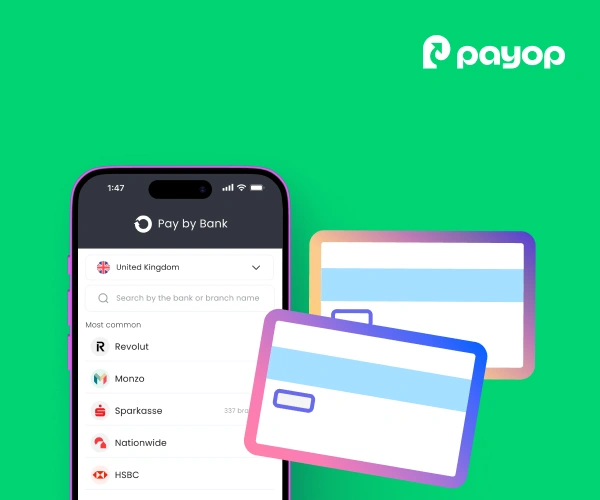
Pay by Bank is a payment method that lets customers pay online directly from their bank accounts. It doesn’t rely on card networks. Instead, Pay by Bank uses open banking APIs to initiate payments directly from customers' bank accounts, with their authorisation.
This lets users authorise transactions from their familiar banking environment, making checkout faster, easier, and more secure.
Here’s how a typical Pay by Bank payment works:
Select Pay by Bank. The customer chooses this method at checkout.
Choose a bank. They pick their bank from a list of supported institutions.
Authorise the transaction. The customer is redirected to their banking app or online banking page. There, they review the payment details and authorise the transaction using a PIN, password, or biometrics.
Return to checkout. After authorising the payment, the customer is usually sent back to the merchant’s website or app. If the payment is successful, they typically receive an immediate confirmation.
So, how are these two things connected? Think of it this way: Pay by Bank is an open banking-powered type of A2A payment, but not all A2As are Pay by Bank.
In other words, account-to-account payments are a broader category of payments that move money between accounts, skipping card networks entirely. Pay by Bank is a specific payment method that uses A2A infrastructure and open banking technology, connecting banking apps with online checkouts.
Let’s compare them side by side to better see what sets them apart.
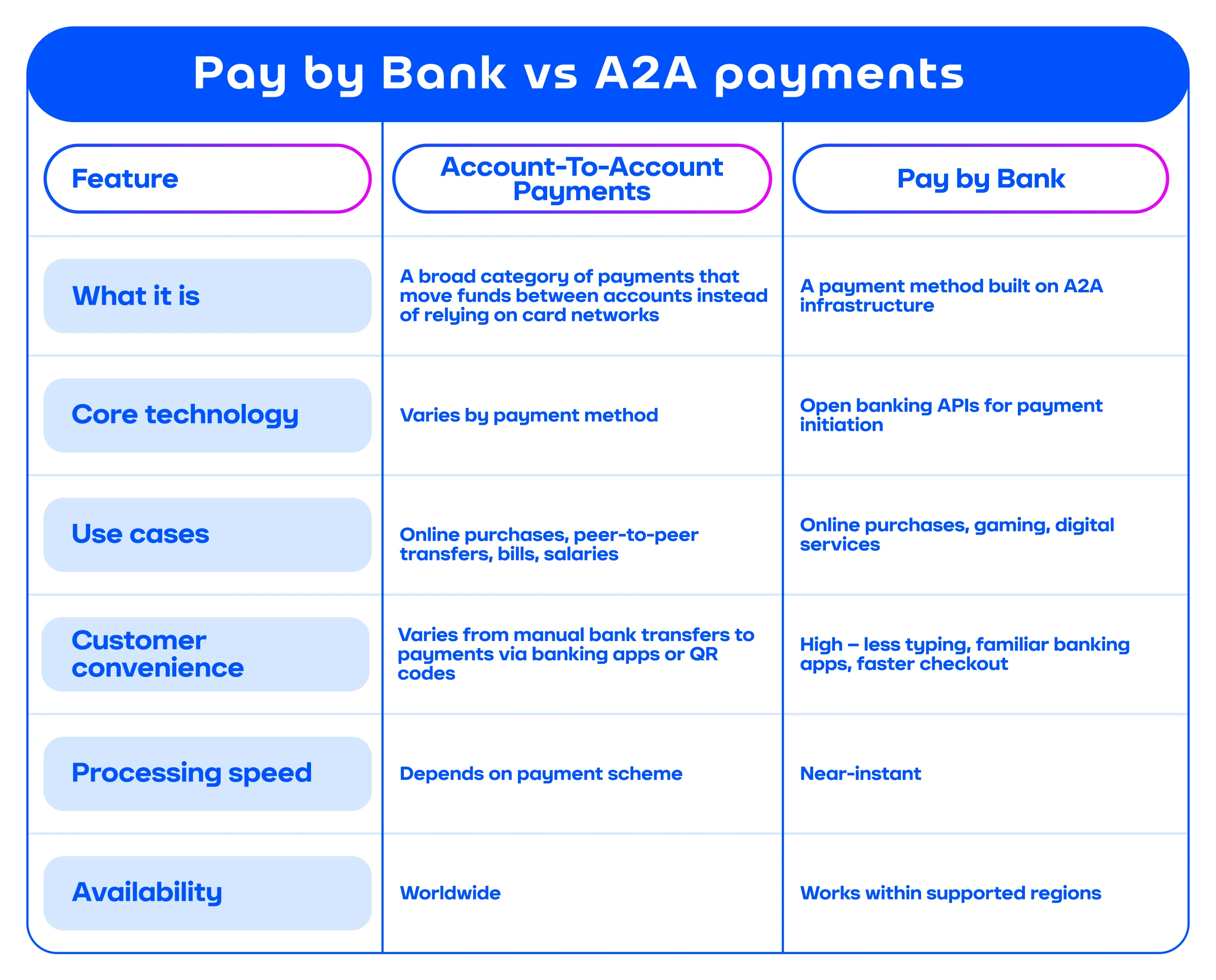
The term open banking came up several times in connection with A2A and specifically Pay by Bank. But what exactly is it, and where does it fit in the context of the discussed payment solutions?
Open banking is the technology that lets authorised third-party providers securely access customers’ banking data through application programming interfaces (APIs), with their permission.
It enables a wide range of financial services, but in this article, we'll focus on one application: payment initiation. Using open banking APIs, payment providers can initiate transactions on a customer's behalf after their approval.
Sounds familiar and a lot like Pay by Bank? Let’s break down the relationship between the three terms we are covering here:
A2A payments are a broad category of payments that move money directly from one bank account to another.
Open banking provides the technology and a regulated framework that enables third-party payment initiation.
Pay by Bank brings the two together in a customer-facing online payment method.
An important note: open banking doesn’t equal instant payments. The speed depends on the underlying bank payment scheme. Open banking only initiates the transaction.
For example, in Europe, Pay by Bank transactions use SEPA Credit Transfer or SEPA Instant Credit Transfer, depending on the provider, bank, and supported payment flow.
People can do more and more things using just their phones these days. For some, it's simply more convenient. For others, a smartphone can be the only access to the internet.
That’s why payment methods like Pay by Bank, which let customers pay in just a few taps, are becoming increasingly relevant.
Here’s how offering Pay by Bank at checkout can benefit your business:
Potentially lower processing costs. Card payments involve different intermediaries, including banks, card networks, and payment processors. Each may add fees to the final cost. A2As, including Pay by Bank, don’t rely on card networks, which can help you save on card fees.
Lower chargeback risks. Authorising payments from a banking app helps ensure the legitimate account holder makes the purchase and reduces chargeback risk, especially friendly fraud.
Faster payments. Pay by Bank transactions, like A2As, are typically near-instant. This means faster access to funds and faster order fulfilment, boosting customer satisfaction.
Better conversion. Pay by Bank lets users pay from their familiar banking apps, which helps build trust. Plus, checkout becomes faster as there’s no need to manually enter payment details. Fast payment confirmation can further improve the experience, especially for time-sensitive purchases. Together, these features can help you boost conversion, especially in markets where bank-based methods are the top choice.
Want to offer your customers a fast, secure and convenient account-to-account payment method? Payop can help with that.
We created our own Pay by Bank solution, powered by open banking technology. This method lets users skip manual card data entry and authorise transactions directly in their banking app. All designed to make checkout as smooth as possible and keep your customers happy.
So, if you’re looking to reduce card abandonment and boost conversion in bank-first regions, Payop’s Pay by Bank may be the right choice.
Contact our team at sales@payop.com to learn more.